
AlmaLinux 10: turning one host into a LAN time source
Test scope
Section titled “Test scope”An AlmaLinux 10.2 Server VM running chrony-4.8-2.el10.
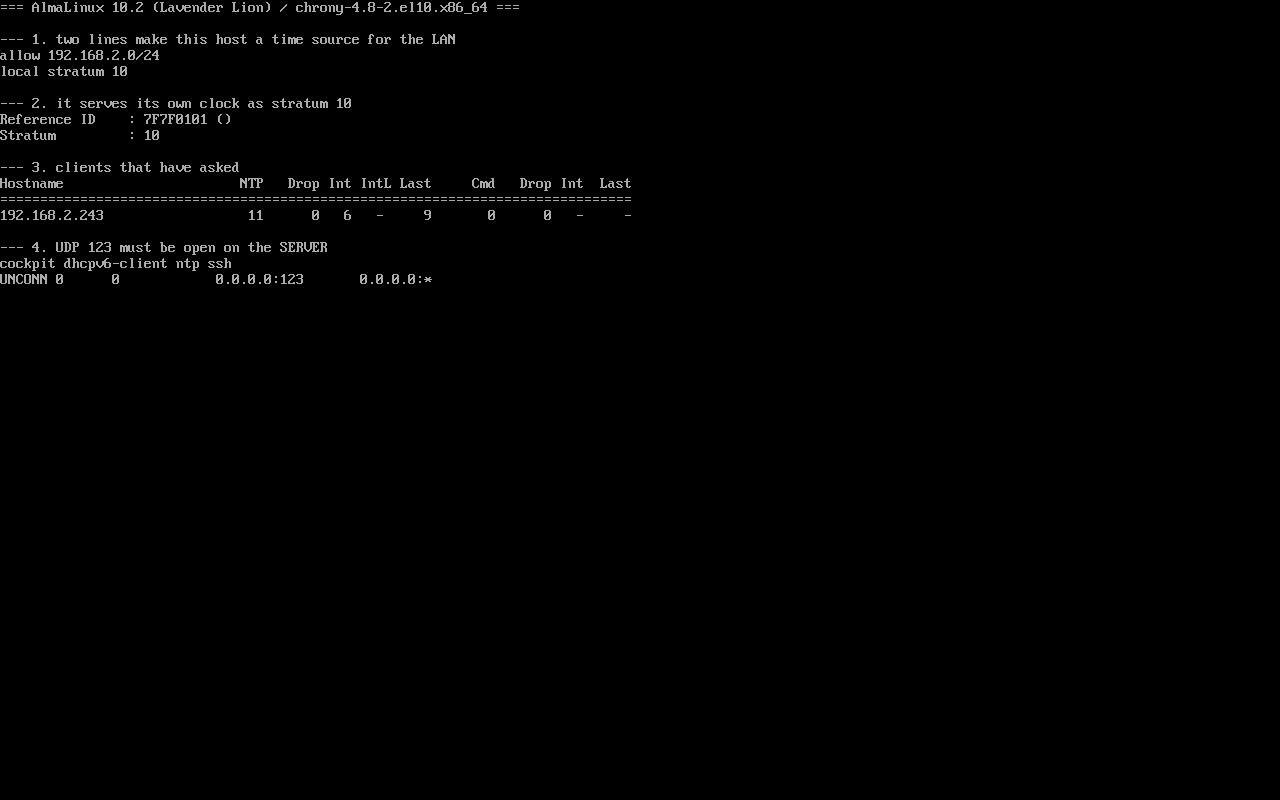
The host has no upstream NTP (the lab has no internet), so two directives make it serve its own clock to the LAN while a second VM syncs from it. Screenshot: public/evidence/chrony/alma-server.png.
Two directives
Section titled “Two directives”$ grep -E '^(allow|local stratum)' /etc/chrony.confallow 192.168.2.0/24local stratum 10allow 192.168.2.0/24: permit clients from that network;local stratum 10: when no upstream is available, act as a stratum 10 reference.
Restart with systemctl restart chronyd.
What the host reports about itself
Section titled “What the host reports about itself”$ chronyc tracking | grep -E '^(Reference ID|Stratum)'Reference ID : 7F7F0101 ()Stratum : 10Reference ID 7F7F0101 (127.127.1.1) is chrony’s marker for the local clock — meaning there is no upstream and the host is running on its own hardware clock. That is fine for a lab and unacceptable for production timekeeping.
Who is asking
Section titled “Who is asking”$ chronyc clientsHostname NTP Drop Int IntL Last Cmd Drop Int Last===============================================================================192.168.2.243 7 0 3 - 28 0 0 - -
$ chronyc serverstats | head -3NTP packets received : 7NTP packets dropped : 0clients shows who is polling and how many packets each sent; serverstats gives the aggregate. Both are server-side checks, which beat guessing from the client.
Open the port
Section titled “Open the port”$ firewall-cmd --list-servicescockpit dhcpv6-client ntp ssh$ ss -lun | grep ':123 ' | head -1UNCONN 0 0 0.0.0.0:123 0.0.0.0:*The Server environment does not include ntp by default: firewall-cmd --permanent --add-service=ntp && firewall-cmd --reload.
When this is acceptable
Section titled “When this is acceptable”| Scenario | Suitable |
|---|---|
| Isolated lab needing one clock | Yes (accuracy follows the host RTC) |
| Production internal time source | No: local is a degraded mode and does not correct frequency drift |
| Short fallback while upstream is down | Temporary, but watch the stratum |
A real time source should track at least two upstreams (pool or two server ... iburst entries); local belongs to fully isolated networks.
Common traps
Section titled “Common traps”allowwithoutlocal stratum: with no upstream the server reports stratum 0 and clients refuse it;- Forgetting to open ntp: clients stay at
^?whileNTP packets receivedstays 0; - Reading
localas “high precision”: it only makes the host usable, accuracy is the hardware clock’s; - Leaving
localafter upstream returns: chrony prefers real upstreams, but the stale directive misleads troubleshooting.
Practice: see what the server sees
Section titled “Practice: see what the server sees”sudo grep -E '^(allow|local stratum)' /etc/chrony.confsudo chronyc serverstats | head -3sudo chronyc clients | head -4sudo firewall-cmd --list-services | tr ' ' '\n' | grep -x ntpChecks:
- The
allownetwork covers the client; NTP packets receivedgrows while the client runs;- The client’s IP appears in
clients; ntpis in the firewall service list.
常见问题
Does local stratum 10 poison upstream?
No. It is a local reference used only when no better source exists; clients see stratum 10 and above.
Can I restrict which clients may query?
Yes — allow takes networks or addresses, and restrict directives can narrow permissions further.
Why is the client stratum 11?
Each hop adds one: a stratum 10 server yields a stratum 11 client.
Next steps
Section titled “Next steps”- Offline updates: /en/offline-updates/
- systemd timers: /en/systemd-timers/
- Services and logs: /en/journald-logging/